

Introduction
There are few dinners as comforting as a steaming bowl of creamy potato soup. The moment the first spoonful reaches the table, you get the aroma of sautéed onion, garlic, butter, and herbs followed by the gentle sweetness of tender potatoes. The texture is the real star: silky and thick enough to coat a spoon, yet light enough to remain spoonable rather than heavy or pasty.
For DaliyDelish.com, this recipe was developed around a simple goal: create one of the most dependable creamy potato soup recipes for home cooks who want restaurant-quality comfort food without complicated techniques or expensive ingredients.
During kitchen testing, the biggest difference came from how the potatoes were cooked and blended. Boiling them aggressively can make the soup watery on the outside and unevenly cooked inside, while over-blending starchy potatoes can create an unpleasant gluey texture. The better approach is gentle simmering, controlled heat, and blending only as much as needed.
The finished soup has a balanced flavor profile. Potatoes provide a mellow, earthy foundation; onion and garlic build savory depth; butter contributes richness; cream creates the luxurious mouthfeel; and a small amount of acidity prevents the finished bowl from tasting flat.
Visually, the soup should be pale golden, smooth, and glossy, with flecks of parsley or chives providing contrast. A little freshly cracked black pepper and a drizzle of cream make it especially inviting.
This recipe is designed as a satisfying Dinner Recipes option, but it also works beautifully for lunch, meal preparation, chilly evenings, casual family dinners, or a starter for a larger meal.
Recipe Quick-Facts Summary Card
| Detail | Information |
| Recipe | Creamy Potato Soup |
| Prep Time | 15 minutes |
| Cook Time | 35 minutes |
| Total Time | 50 minutes |
| Skill Level | Easy to Intermediate |
| Servings | 6 |
| Estimated Calories | About 300 calories per serving |
| Estimated Cost | Approximately 1.50–2.25 per serving |
| Primary Diet Type | Vegetarian |
| Cuisine Style | American-inspired comfort food |
| Texture | Creamy, velvety, spoon-coating |
| Best For | Dinner, lunch, meal prep, cold-weather meals |
Nutrition and cost estimates are approximate and vary according to brands, serving sizes, and ingredient choices.
Why This Recipe Works
- It builds flavor in layers. Rather than putting every ingredient into the pot at once, the onions and garlic are gently sautéed in butter first. This develops sweetness and savory depth before the potatoes and broth are added.
- The potatoes create natural body. Potatoes contain starch that helps thicken the soup naturally. This means you do not need to rely heavily on flour or cornstarch to achieve a creamy consistency.
- Gentle simmering protects texture. The potatoes are cooked until fork-tender rather than aggressively boiled. This gives them an even texture and makes them easier to blend smoothly.
- The cream is added at the right stage. Dairy is best incorporated toward the end rather than boiled hard for an extended period. This helps maintain a smooth, rich finish and reduces the chance of scorching.
- It is budget-friendly and flexible. Potatoes, onions, garlic, broth, and dairy are relatively accessible ingredients. You can also adapt the recipe with vegetables, herbs, dairy-free alternatives, or cauliflower depending on your dietary needs.
The result is a soup that tastes considerably more sophisticated than its inexpensive ingredient list suggests.
Kitchen Tools & Equipment Guide

You do not need professional restaurant equipment to make excellent creamy potato soup, but the right tools make the process easier.
Essential Equipment
- Large heavy-bottomed pot or Dutch oven: Provides even heat and reduces the risk of scorching.
- Chef’s knife: A sharp knife makes it easier to cut potatoes into uniform pieces.
- Cutting board: Use a separate clean area for produce preparation.
- Wooden spoon or heat-resistant spatula: Useful for scraping flavorful browned bits from the bottom.
- Immersion blender: The easiest tool for blending soup directly in the cooking pot.
- Regular blender: Produces an exceptionally smooth texture, although hot liquids require caution.
- Ladle: Makes serving easier and helps portion the soup consistently.
- Instant-read thermometer: Useful when checking reheating temperatures and maintaining food-safety practices.
Uniform potato pieces are particularly important. Pieces of similar size cook at approximately the same rate, preventing some potatoes from becoming mushy while others remain firm.
Ingredient Selection, Quality & Substitutions
Core Ingredients
For 6 servings:
- 2 lb russet or Yukon Gold potatoes (900 g), peeled and diced
- 3 tablespoons unsalted butter (42 g)
- Approximately 150 grams of finely diced yellow onion, medium sized
- 3 garlic cloves, minced (about 9 g)
- 4 cups low-sodium chicken or vegetable broth (960 ml)
- 1 cup whole milk (240 ml)
- 1 cup heavy cream (240 ml)
- 1 teaspoon kosher salt (about 5 g), or to taste
- ½ teaspoon freshly ground black pepper (about 1 g)
- ½ teaspoon dried thyme (about 1 g)
- ¼ teaspoon smoked paprika (about 0.5 g)
- 1 tablespoon fresh lemon juice (15 ml)
- 2 tablespoons chopped fresh parsley or chives (about 8 g)
Choosing the Right Potatoes
Yukon Gold potatoes are an excellent choice when you want naturally buttery flavor and a creamy texture. Their moderate starch level makes them particularly forgiving.
Russet potatoes contain more starch and can create a thicker soup. They are excellent for a classic creamy consistency, but avoid excessive blending because their high starch content can become gluey.
For the best balance, you can also use a combination of Yukon Gold and russet potatoes.
Butter
Using unsalted butter gives you greater control over the sodium content. Butter contributes richness and helps carry the flavors of onion, garlic, and herbs throughout the soup.
Broth
Low-sodium broth is preferable because commercial broths vary considerably in salt content. You can increase seasoning gradually instead of discovering at the end that the soup is too salty.
Vegetable broth keeps the recipe vegetarian. Chicken broth adds a slightly deeper savory character but means the finished soup is not vegetarian.
Milk and Cream
Whole milk provides body without making the soup excessively heavy. Heavy cream supplies the luxurious finish associated with classic creamy potato soup.
For a lighter version, replace the heavy cream with additional whole milk or evaporated milk. There will be less richness but still a creamy texture.
Tested Dairy-Free Substitution
For a dairy-free version:
- Replace butter with olive oil or plant-based butter.
- Replace whole milk with unsweetened oat milk or another suitable unsweetened plant milk.
- Replace heavy cream with unsweetened full-fat coconut milk or a dairy-free cooking cream.
Choose an unsweetened plant milk so the soup does not develop an unexpected sweet flavor.
Lower-Sodium Version
Use low-sodium or no-salt-added broth and season gradually. Fresh herbs, garlic, black pepper, thyme, lemon juice, and smoked paprika can add flavor without depending entirely on salt.
Keto-Friendly Alternative
Traditional potato soup is not keto-friendly because potatoes are a carbohydrate-rich ingredient. If you are following a ketogenic diet, replace the potatoes with cauliflower.
The cooking method remains similar, although cauliflower generally cooks more quickly. The resulting soup will have a different flavor and texture, but it can still be creamy and satisfying.
Culinary Masterclass: Step-by-Step Instructions
Step 1: Prep Work & Seasoning
Begin by washing and peeling the potatoes. Cut them into approximately 1-inch / 2.5-cm pieces.
Uniformity matters more than perfection. The goal is to create pieces that finish cooking at approximately the same time.
Finely dice the onion and mince the garlic. Chop the parsley or chives and keep them refrigerated until needed.
Measure your broth, milk, cream, and seasonings before beginning. Once the cooking starts, having everything ready allows you to concentrate on temperature control.
Place a heavy-bottomed Dutch oven or soup pot over medium heat.
Add the butter and allow it to melt gently. It should become glossy and fragrant without smoking.
Add the diced onion.
Cook for approximately 5–7 minutes, stirring occasionally. The onion should become soft and translucent with lightly golden edges. You are looking for sweetness and aroma, not deeply browned onions.
Add the garlic, thyme, and smoked paprika.
Cook for approximately 30–60 seconds, stirring constantly. The garlic should smell fragrant but should not turn dark brown. Burned garlic can introduce a harsh bitterness that is difficult to correct later.
Season lightly with salt and black pepper. creamy potato soup recipes
Step 2: Searing & Sautéing
This recipe does not require searing meat. Instead, this stage focuses on sautéing the aromatic foundation that gives the soup depth.
Add the diced potatoes to the pot.
Stir thoroughly so the potatoes become coated with the seasoned butter and aromatics.
Cook for approximately 2–3 minutes, stirring gently.
You should hear a quiet sizzle. You are not trying to brown every potato surface; the goal is to lightly coat and warm them while allowing the butter and aromatics to cling to their surfaces.
If the pot looks dry, add a small splash of broth rather than increasing the heat dramatically.
Add the broth and scrape the bottom of the pot with your wooden spoon.
This releases flavorful material from the sautéing stage and distributes it throughout the liquid.
Bring the mixture to a gentle simmer.
Avoid a violent rolling boil. Strong boiling can cause excessive evaporation and may cook the potatoes unevenly.
Step 3: Sauce Building & Simmering
Once the broth reaches a gentle simmer, reduce the heat to medium-low.
Cover the pot partially with a lid and simmer for approximately 18–25 minutes, depending on the size of your potato pieces.
Check the potatoes with a fork after about 18 minutes.
The fork should slide through the center with very little resistance. If the potato still feels firm in the middle, continue simmering for several more minutes.
This is one of the most important sensory checkpoints in the recipe.
The potatoes should be tender enough to crush easily but should not be absorbing so much liquid that they completely disintegrate before blending.
Once tender, turn the heat to low.
Add the whole milk and heavy cream.
Stir slowly.
Do not allow the dairy mixture to reach an aggressive boil. Gentle heating is enough.
At this point, taste the broth carefully.
Adjust salt and black pepper gradually.
Now blend the soup.
For a completely smooth texture, use an immersion blender directly in the pot. Move it slowly through different areas of the soup while keeping the blade fully submerged to reduce splashing.
If using a countertop blender, work in small batches and never fill the container completely with hot liquid. Remove or loosen the vent according to your blender manufacturer’s instructions and cover the opening with a folded kitchen towel to protect against splashes.
For a more rustic soup, blend approximately two-thirds of the mixture and leave some small potato pieces intact.creamy potato soup recipes
Step 4: Finishing, Resting, and Garnishing
Once blended, return the soup to very low heat if necessary.
Do not aggressively boil the finished soup.
Add the lemon juice and stir.
The lemon juice may seem like a small ingredient, but it plays an important culinary role. Cream and butter provide richness, while a small amount of acidity makes that richness taste brighter and prevents the soup from becoming one-dimensional.
Taste again.
Ask yourself:
- Does it need more salt?
- Is the texture creamy enough?
- Does it need another small splash of lemon?
- Is the pepper noticeable without becoming dominant?
If the soup is too thick, add warm broth a few tablespoons at a time.
If it is too thin, allow it to simmer gently uncovered for a few minutes while stirring regularly.
Let the soup rest for approximately 3–5 minutes before serving. This gives the starches time to settle and allows the flavors to integrate.
Ladle into warm bowls.
Finish with chopped parsley or chives, freshly cracked black pepper, and an optional small swirl of cream.
For extra texture, top with crisp toasted bread cubes, roasted potato pieces, or a modest amount of shredded cheese.
The finished soup should be velvety rather than sticky, creamy rather than watery, and richly aromatic without tasting excessively heavy.
Cooking Secrets and Expert Techniques from a Chef
Great soup is not simply a matter of following a list of ingredients. Temperature, starch, fat, acidity, and timing all influence the final result.
Build Aromatics Before Adding Liquid
Onions contain natural sugars and flavor compounds that become sweeter and more complex as they soften. Cooking them gently in butter creates the flavor foundation for the soup.
Garlic requires much less time. Adding it too early can cause it to burn before the onions are ready.
Understand the Maillard Reaction
The Maillard reaction occurs when proteins and sugars react at sufficiently high temperatures, creating browned flavors and aromas. A traditional potato soup is not heavily dependent on Maillard browning, but lightly sautéing the aromatics can add complexity.
Do not confuse browning with burning. Golden edges are desirable; blackened garlic is not.
Control Potato Starch
Potato starch is helpful because it naturally thickens the soup. However, excessive mechanical agitation can release too much starch.
That is why an immersion blender should be used strategically rather than continuously for several minutes.
For an ultra-smooth soup, blend until just combined and silky. Stop when you have reached the desired texture.
Balance Fat With Acidity
Cream and butter provide fat and richness. Fat carries aromatic compounds and gives the soup a luxurious mouthfeel.
But richness needs balance.
A small amount of lemon juice adds acidity, which helps the palate perceive the soup as brighter and more balanced.
You should not taste obvious lemon. If you do, you have probably added too much.
Chef’s Texture Trick
For a soup with both creamy and chunky textures, remove approximately one cup of cooked potatoes before blending.
Blend the remaining soup until smooth, then return the reserved potato pieces.
This gives you the appearance and mouthfeel of a carefully prepared restaurant soup without requiring complicated techniques.
Common Cooking Mistakes & Troubleshooting Guide
Mistake 1: Boiling the Soup Too Aggressively
A rolling boil can cause excessive evaporation and may produce unevenly cooked potatoes.
Fix: Reduce the heat and maintain a gentle simmer. Add a little broth if the liquid level has dropped too far.
Mistake 2: Over-Blending
Over-processing starchy potatoes can create a gluey or elastic texture.
Fix: Blend only until the desired consistency is reached. If the soup is already too thick and sticky, adding warm broth can loosen it somewhat, although severely over-processed potatoes cannot always be fully restored.
Mistake 3: Adding Too Much Salt Too Early
Broth brands vary widely in sodium content. As water evaporates, the salt concentration can increase.
Fix: Season lightly at the beginning and make the final adjustments after the soup has finished cooking.
Mistake 4: Boiling the Dairy
High heat can cause dairy-based soups to develop an unpleasant texture or scorch on the bottom.
Fix: Add milk and cream after the potatoes are tender, then heat gently. Keep the soup below a vigorous boil.
If the Soup Is Too Thin
Simmer it gently uncovered for several minutes, stirring frequently.
Alternatively, blend a few additional cooked potato pieces into the soup.
If the Soup Is Too Thick
Add warm broth gradually. Do not pour in a large quantity at once because you may overshoot the desired consistency. creamy potato soup recipes.
If the Soup Tastes Flat
First check the salt level. Then consider a small amount of lemon juice or freshly ground black pepper.
Rich soups often need seasoning and acidity, not more cream.
Safe food storage, meal preparation, and reheating
Food safety is especially important with dairy-containing soups.
Safe Handling
Wash your hands before preparation and keep cutting surfaces clean.
Avoid using the same cutting board or utensils for raw animal products and ready-to-eat ingredients without proper washing and sanitizing.
Because this recipe can be prepared with either vegetable or chicken broth, check the broth ingredients if dietary restrictions are important.
If adding cooked chicken or another protein, ensure it reaches an internal temperature of 165°F / 74°C as measured with an instant-read thermometer.
Refrigeration
Transfer leftover soup into shallow containers to encourage faster cooling.
Refrigerate promptly rather than leaving the soup at room temperature for an extended period.
For best quality, consume refrigerated leftovers within approximately 3–4 days.
Freezing
Potato-and-cream soups can change texture after freezing. The dairy may separate slightly and potatoes can become grainier.
If you know you intend to freeze the soup, consider preparing the potato base without the cream. Cool and freeze the base, then add fresh dairy while reheating.
For already finished soup, freezing is still possible, but expect some texture changes.
Reheating
Reheat gently in a saucepan over medium-low to low heat.
Stir frequently, especially around the bottom and edges of the pan.
Do not use high heat to rush the process.
For food safety, leftovers should be reheated thoroughly and should reach approximately 165°F / 74°C before serving.
If the soup becomes too thick after refrigeration, add a splash of broth or milk while reheating.
Nutrition & Dietary Considerations
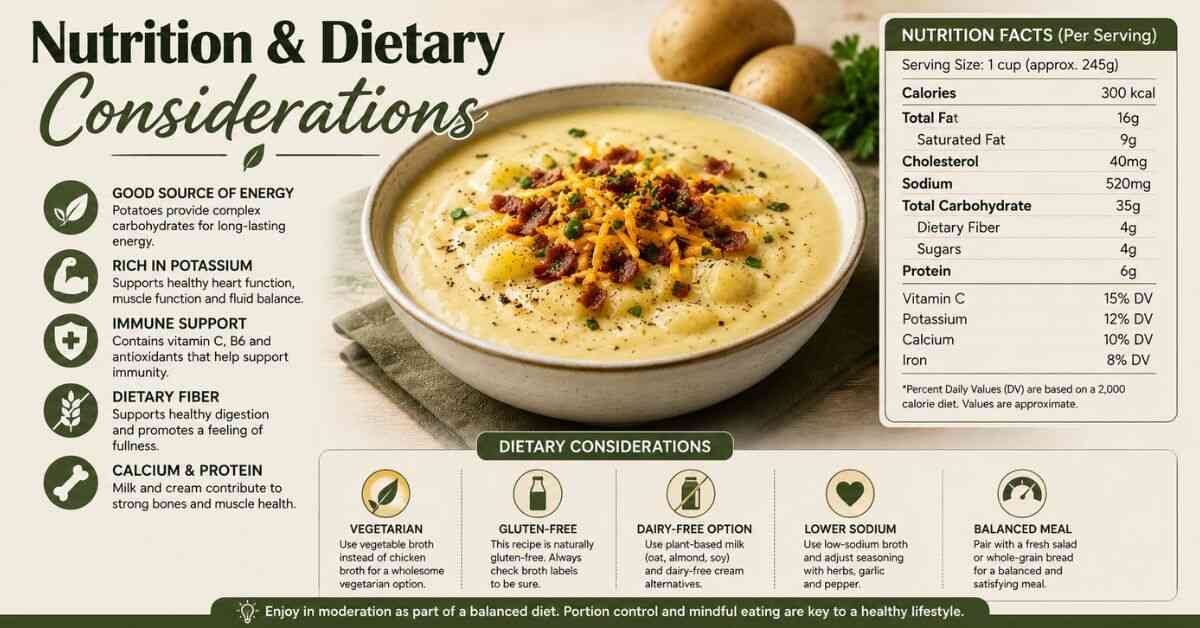
The following estimate is based on six servings made with potatoes, butter, whole milk, heavy cream, and low-sodium broth. Actual values will vary depending on ingredient brands and portion sizes.
Estimated Nutrition Per Serving
- Calories: ~300 kcal
- Protein: ~6 g
- Carbohydrates: ~35 g
- Fat: ~16 g
- Fiber: ~4 g
- Sodium: ~500–650 mg
These figures are estimates rather than laboratory measurements.
Potatoes contribute carbohydrates, potassium, and some fiber, particularly when some of the potato skin is retained. However, this soup should not be described as low-carbohydrate in its traditional form.
For a lower-carbohydrate alternative, substitute cauliflower for the potatoes.
For a vegetarian version, use vegetable broth.
Suitable plant-based butter and unsweetened dairy alternatives can be used to make a dairy-free version.
You can reduce the butter and cream and use more unsweetened milk or a suitable alternative if you want a lower saturated-fat version.
When making dietary changes, consider the nutritional profile of the complete meal rather than focusing on a single ingredient.
Pairings & Serving Suggestions
Creamy potato soup is satisfying on its own, but the right side dishes can transform it into a complete dinner.
Fresh Salad
A crisp green salad with lettuce, cucumber, radishes, tomatoes, and a light vinaigrette provides freshness and acidity.
The contrast works particularly well because the soup is soft, warm, and creamy.
Crusty Bread
Serve the soup with:
- Sourdough
- Whole-grain bread
- French baguette
- Garlic toast
- Homemade dinner rolls
A crusty exterior with a soft interior is ideal for dipping into the soup.
Roasted Vegetables
Roasted broccoli, carrots, Brussels sprouts, or green beans provide caramelized flavor and textural contrast.
Protein Pairings
If you want a heartier dinner, serve a moderate portion of:
- Grilled chicken
- Roasted turkey
- Baked salmon
- Herb-seasoned white fish
- Beans or lentils
For a vegetarian table, roasted chickpeas can add both crunch and plant-based protein.
Toppings
A topping bar makes the soup especially enjoyable for families.
Try:
- Fresh chives
- Parsley
- Black pepper
- Shredded cheddar
- Toasted bread cubes
- Crispy onions
- Plain yogurt
- A small drizzle of cream
Beverage Pairings
For a non-alcoholic option, sparkling water with lemon provides refreshing acidity. Unsweetened iced tea or a light herbal tea can also complement the creamy soup.creamy potato soup recipes
Final Verdict & Reader Invitation
A great bowl of creamy potato soup does not require complicated ingredients or advanced restaurant equipment. With properly cooked potatoes, patiently sautéed aromatics, controlled heat, balanced seasoning, and a small finishing touch of acidity, you can create a deeply comforting dinner from everyday ingredients.
This DaliyDelish recipe is designed to be flexible enough for weeknight cooking while still delivering the silky texture and layered flavor expected from a professionally developed soup.
Simple Ingredients, Delicious Results
Give this creamy potato soup recipe a try, rate it with your stars, and share your results in the DaliyDelish.com comments. If you made a substitution or discovered your own favorite topping, tell other readers what worked for you!
Yukon Gold and russet potatoes are excellent choices. Yukon Gold potatoes produce a naturally buttery, creamy texture, while russets contain more starch and can create a thicker soup. Avoid over-blending either variety because excessive processing can make the soup gluey.
Potatoes naturally contain starch, so flour is not essential. Simmer the potatoes until completely tender and blend some or all of them with the broth. Milk or cream can then provide additional richness. This method creates a creamy texture while keeping the ingredient list simple.
Yes, but dairy-based potato soup may experience texture changes after freezing and thawing. Cream can separate slightly, while potatoes may become somewhat grainy. For best results, freeze the potato-and-broth base before adding dairy, then finish the soup with fresh milk or cream during reheating.
The simplest method is to blend more of the cooked potatoes into the liquid. You can also simmer the soup uncovered for a short time to reduce excess liquid. Avoid adding large amounts of flour or starch without first checking the natural consistency because potatoes already provide significant thickening power.

Tosique Haider -Passionate writer sharing informative, engaging, and easy-to-read articles across different topics. Focused on delivering valuable content that helps readers learn, explore, and stay inspired every day.