Introduction:
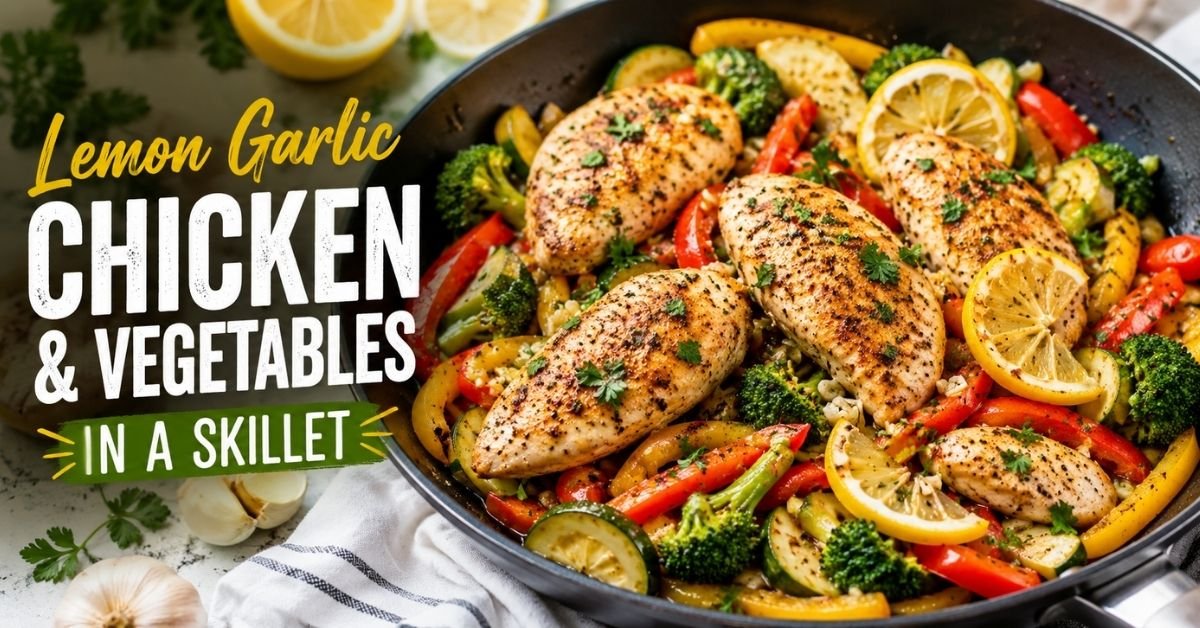
When you need a dinner that is simple, healthy, flavorful, and genuinely satisfying, chicken is one of the most dependable ingredients to keep in your kitchen. The challenge is making chicken that is healthy without turning it into a dry, bland meal. That is exactly what this Lemon Garlic Chicken & Vegetable Skillet is designed to solve.
This recipe combines tender, golden-brown chicken breast with colorful vegetables and a bright lemon-garlic pan sauce. The chicken develops a beautifully browned exterior while remaining juicy inside, and the vegetables retain just enough bite to create contrast with the tender meat.
In the DaliyDelish kitchen, this recipe was developed and tested with a practical question in mind: Can a busy home cook prepare a wholesome chicken dinner using ordinary ingredients without sacrificing restaurant-style flavor? The answer is yes.
The first thing you notice while cooking is the aroma. As the seasoned chicken hits the hot skillet, you get the savory fragrance of garlic, herbs, and toasted spices. Once the vegetables are added, their natural sweetness begins to emerge. Lemon juice added near the end cuts through the richness of the olive oil and creates a clean, fresh finish.
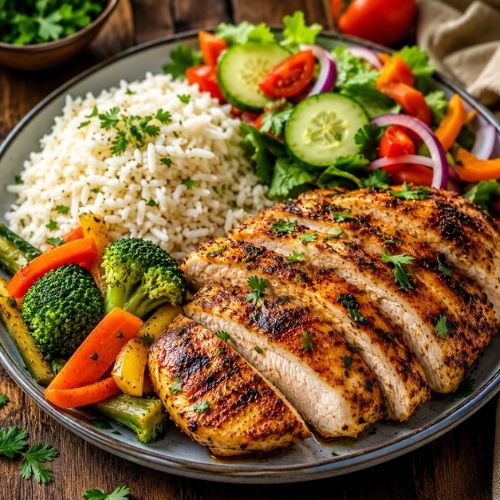
Visually, the dish is equally appealing. Golden chicken pieces sit among green broccoli, colorful bell peppers, and tender zucchini, while the glossy pan sauce coats everything lightly.
The mouthfeel is what makes this dish especially enjoyable: juicy chicken, lightly crisp vegetables, and a silky but fresh sauce.
This is one of those simple healthy chicken dinners that works equally well for a quick weeknight meal, meal preparation, or a relaxed family dinner.
Recipe Quick-Facts Summary Card
| Recipe Detail | Information |
| Recipe | Lemon Garlic Chicken & Vegetable Skillet |
| Category | Chicken Recipes / Healthy Dinner |
| Prep Time | 15 minutes |
| Cook Time | 20 minutes |
| Total Time | 35 minutes |
| Skill Level | Easy to Intermediate |
| Servings | 4 |
| Estimated Calories | Approximately 390 kcal per serving |
| Estimated Cost | Approximately $3.50–$5.00 per serving, depending on location |
| Primary Diet Type | High-Protein, Naturally Gluten-Free |
| Cooking Method | Stovetop skillet |
| Best For | Weeknight dinners, meal prep, family meals |
| Main Protein | Boneless, skinless chicken breast |
Nutrition and cost figures are estimates and can vary according to brands, ingredient sizes, preparation methods, and portion sizes.
Why This Recipe Works
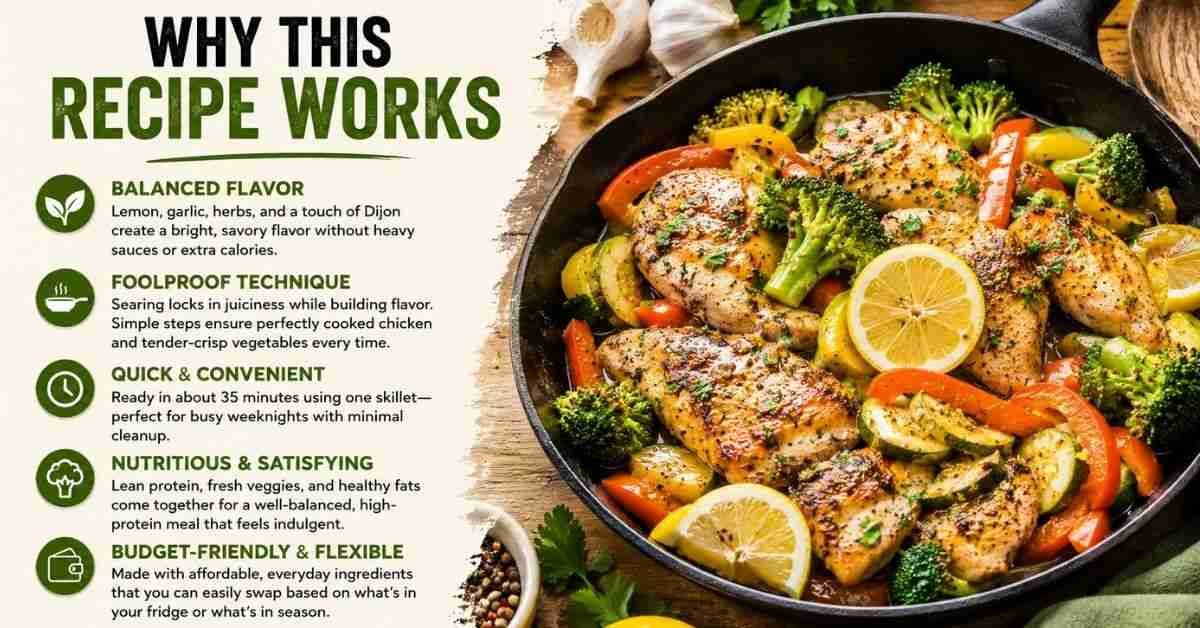
There are plenty of chicken recipes available, but the best simple healthy chicken dinners need to satisfy several requirements at once. This skillet recipe succeeds because it focuses on technique rather than complicated ingredients.
- Balanced flavor without heavy ingredients: Lemon provides acidity, garlic contributes savory depth, olive oil supplies richness, and herbs create aromatic complexity. The result tastes satisfying without requiring a heavy cream-based sauce.
- A reliable chicken-cooking technique: Cutting the chicken into evenly sized pieces helps it cook more consistently. Searing over properly heated oil encourages browning while keeping the cooking time short.
- Vegetables cook in stages: Broccoli, bell peppers, and zucchini do not all soften at the same speed. Adding them strategically helps preserve their individual textures instead of producing a soft, watery mixture.
- One-skillet convenience: Cooking most of the meal in one skillet minimizes cleanup and allows the vegetables to benefit from the flavorful browned bits left behind by the chicken.
- Flexible and budget-friendly: Chicken breast and common vegetables are widely available and easy to substitute. You can use seasonal vegetables or whatever is already in your refrigerator, making this a practical meal rather than a specialty recipe.
Kitchen Tools & Equipment Guide
You do not need a professional kitchen to make this dish successfully, but the right equipment makes the process easier.
Essential Equipment
- Large skillet: A 10–12-inch heavy-bottomed skillet provides enough surface area to brown the chicken without excessive crowding.
- Sharp chef’s knife: A sharp knife makes it easier to cut chicken and vegetables evenly.
- Cutting board: Ideally use a separate board for raw poultry or wash and sanitize it thoroughly before using it for other foods.
- Instant-read thermometer: This is the most reliable way to verify chicken doneness. Chicken should reach 165°F / 74°C internally.
- Tongs: Useful for turning chicken pieces without piercing them unnecessarily.
- Measuring spoons: Helpful for maintaining consistent seasoning.
A heavy skillet retains heat well, which is particularly useful for achieving the browned surface that gives this recipe its characteristic savory flavor.
Ingredient Selection, Quality & Substitutions
Main Ingredients
| Ingredient | US Customary | Metric |
| Boneless, skinless chicken breasts | 1½ lb | 680 g |
| Olive oil | 2 tbsp | 30 mL |
| Broccoli florets | 2 cups | 180 g |
| Bell pepper, sliced | 1 large | 150 g |
| Zucchini, sliced | 1 medium | 200 g |
| Garlic, minced | 4 cloves | About 12 g |
| Fresh lemon juice | 2 tbsp | 30 mL |
| Low-sodium chicken broth | ½ cup | 120 mL |
| Italian seasoning | 1 tsp | 3 g |
| Paprika | 1 tsp | 2 g |
| Black pepper | ½ tsp | 1 g |
| Salt | ½ tsp, or to taste | About 3 g |
| Dijon mustard | 1 tsp | 5 g |
| Fresh parsley | 2 tbsp | 8 g |
| Lemon zest | 1 tsp | 2 g |
Chicken
Boneless, skinless chicken breast is used because it is lean, widely available, and cooks quickly. Choose breasts that look fresh, have a consistent color, and are not excessively watery.
For especially thick breasts, slice them horizontally into thinner cutlets or cut them into evenly sized pieces. Uniformity matters more than exact shape because similarly sized pieces finish cooking at approximately the same time.
It is possible to substitute boneless, skinless chicken thighs. They contain more fat and have a richer flavor, but they generally require slightly different cooking times.
Olive Oil
Extra-virgin olive oil provides both cooking fat and fruity flavor. A standard olive oil also works well.
If you prefer a more neutral flavor, avocado or another suitable cooking oil can be substituted.
Vegetables
Broccoli contributes a pleasant bite and earthy flavor. Bell pepper brings sweetness and color, while zucchini adds moisture and a tender texture.
You can substitute:
- Green beans for broccoli
- Yellow squash for zucchini
- Mushrooms for some of the vegetables
- Asparagus for broccoli
- Snow peas for bell pepper
Avoid dramatically increasing the amount of vegetables without also considering skillet capacity. Overcrowding creates steam instead of browning.
Garlic, Lemon & Mustard
Garlic creates the savory aromatic foundation. Lemon juice supplies acidity, while Dijon mustard adds subtle sharpness and helps give the pan sauce more character.
For a milder garlic flavor, use two cloves instead of four.
Low-Sodium Broth
The final salt level can be controlled with low-sodium chicken broth. Regular broth can also be used, but taste the sauce before adding additional salt.
Dairy-Free, Low-Sodium & Keto-Friendly Adjustments
The recipe is naturally dairy-free as written.
For a lower-sodium version, use unsalted broth and reduce or omit added salt while relying more heavily on lemon juice, garlic, black pepper, and herbs.
For a lower-carbohydrate or keto-style meal, serve the chicken and vegetables without rice, pasta, or bread and check the nutrition labels of packaged ingredients such as broth and mustard.
Culinary Masterclass: Step-by-Step Instructions
Step 1: Prep Work & Seasoning
Begin by preparing all ingredients before turning on the stove. This is especially important with skillet recipes because once the pan is hot, the cooking process moves quickly.
Pat the chicken dry with paper towels. Removing excess surface moisture is one of the simplest ways to encourage browning.
Cut the chicken into approximately 1-inch pieces. Try to keep the pieces similar in size.
Place the chicken in a bowl and season with paprika, Italian seasoning, black pepper, and salt.
The seasoning should coat the chicken evenly after you toss it.
Next, prepare the vegetables. Cut the broccoli into bite-sized florets, slice the bell pepper into strips, and cut the zucchini into half-moons.
Mince the garlic and keep it separate because garlic cooks much faster than chicken and vegetables.
Measure the broth, lemon juice, and Dijon mustard before cooking.
Chef’s testing note: Having everything ready prevents the common mistake of allowing garlic to burn while you are still measuring the sauce ingredients.
Step 2: Searing & Sautéing
Place a large skillet over medium-high heat.
Add the olive oil and allow it to heat for approximately 30–60 seconds.
You want the oil to look fluid and lightly shimmer, but it should not be smoking heavily.
Add the seasoned chicken in a single layer.
If your skillet is small, cook the chicken in two batches. Crowding the pan traps moisture and makes it harder for the chicken to brown.
Allow the chicken to cook undisturbed for approximately 2–3 minutes on the first side.
You should hear a steady sizzle.
Turn the pieces and continue cooking until multiple sides are golden brown.
The chicken does not necessarily need to be completely cooked at this stage because it will finish later in the sauce. However, always verify doneness before serving.
Transfer the browned chicken to a clean plate.
Do not wipe the skillet clean. Those browned bits on the bottom are concentrated sources of flavor.
Reduce the heat slightly and add the broccoli and bell pepper.
Cook for approximately 3 minutes, stirring occasionally.
Add the zucchini and continue cooking for another 2–3 minutes.
The vegetables should look brighter in color and be tender-crisp rather than mushy.
If the skillet appears completely dry, add a small splash of broth.
Step 3: Sauce Building & Simmering
Push the vegetables toward the sides of the skillet, creating a small open area in the center.
Add the minced garlic.
Cook for approximately 20–30 seconds, stirring constantly.
You should smell the garlic becoming fragrant almost immediately.
Do not let it become dark brown. Burned garlic develops a bitter flavor that can overpower the entire dish.
Add the chicken broth, lemon juice, and Dijon mustard.
Using a wooden spoon or silicone spatula, scrape the bottom of the skillet gently.
This process loosens the browned bits and incorporates them into the sauce.
Bring the liquid to a gentle simmer.
Return the chicken and any accumulated juices from the plate to the skillet.
Stir everything together.
Allow the chicken and vegetables to simmer gently for approximately 3–5 minutes, or until the chicken reaches a safe internal temperature.
Insert an instant-read thermometer into the thickest portion of a chicken piece.
The target is 165°F / 74°C.
Do not rely exclusively on color to determine whether chicken is safely cooked. A thermometer provides a much more dependable measurement.
Once the chicken reaches the proper temperature, remove the skillet from the heat.
Step 4: Finishing, Resting, and Garnishing
Taste the sauce.
This is the moment to adjust the final balance.
If it tastes flat, a small squeeze of fresh lemon can brighten it.
If it needs more savory depth, a small amount of additional Dijon mustard or herbs may help.
Stir in a few drops of broth or allow it to simmer briefly if it tastes too sharp.
Sprinkle fresh parsley and lemon zest over the skillet.
Let the chicken rest for approximately 2–3 minutes before serving.
The short rest allows the meat to settle while the sauce thickens slightly as it cools.
For the best presentation, spoon vegetables onto each plate first, place chicken over the top, and drizzle the remaining lemon-garlic sauce around the dish.
The finished chicken should have a golden exterior, a moist interior, and a fresh lemon-garlic aroma.
The Science of Flavor & Chef’s Insider Techniques
Great home cooking is not simply about following measurements. Understanding a few basic culinary principles makes it much easier to reproduce good results.
The Maillard Reaction
The golden-brown surface of the chicken is primarily the result of the Maillard reaction, a series of chemical reactions that occur when proteins and sugars are exposed to sufficiently high heat.
This creates many of the roasted, savory aromas associated with browned meat.
Moisture is the enemy of quick browning. That is why patting the chicken dry before seasoning is useful.
Pan Temperature Control
A skillet that is too cool encourages steaming. A pan that is excessively hot can burn the exterior before the center cooks.
Medium-high heat is a useful starting point for searing, followed by a reduction in heat when cooking the vegetables and building the sauce.
Watch the food rather than relying entirely on the stove’s numerical setting.
Why Chicken Should Rest
Resting is not magic and does not completely prevent juices from moving when meat is cut. However, allowing cooked chicken to rest briefly gives the meat time to stabilize after cooking and can make the eating experience juicier and more pleasant.
Fat Plus Acid Equals Balance
Olive oil provides richness, but too much richness can make a meal feel heavy.
Lemon juice introduces acidity, which helps brighten the overall flavor.
This is why the lemon should be added toward the finishing stage rather than relying solely on acidity during the long cooking process.
Salt in Stages
Rather than heavily salting the dish at the beginning, season the chicken lightly and adjust the finished sauce after the broth and other ingredients have been incorporated.
Your final flavor will be more controlled this way.
Common Cooking Mistakes & Troubleshooting Guide
Mistake 1: Overcrowding the Skillet
Problem: Chicken becomes pale and watery rather than golden brown.
Why it happens: Too many pieces release moisture into the pan, reducing the surface temperature.
Fix: Cook in batches and leave space between pieces.
Mistake 2: Cutting Chicken Too Large
Problem: The outside becomes brown while the center takes much longer to cook.
Fix: Cut chicken into similarly sized pieces, preferably around 1 inch thick.
If you already have large pieces in the pan, reduce the heat slightly and continue cooking until the thickest portion reaches 165°F / 74°C.
Mistake 3: Burning the Garlic
Problem: The sauce tastes bitter or harsh.
Why it happens: Garlic was added while the skillet was too hot or left unattended.
Fix: Lower the heat before adding garlic and cook it briefly, just until fragrant.
If the garlic is severely burned, it is usually better to remove it and rebuild the sauce rather than attempting to disguise the bitterness.
Mistake 4: Mushy Vegetables
Problem: Vegetables lose their color and texture.
Why it happens: They were cooked too long or simmered in excessive liquid.
Fix: Add firm vegetables first and softer vegetables later. Keep the sauce at a gentle simmer rather than a vigorous boil.
If the Sauce Is Too Thin
Allow it to simmer uncovered for a few additional minutes.
If the Sauce Is Too Strong
Add a small amount of unsalted or low-sodium broth and taste again.
If the Dish Tastes Flat
Try a small amount of lemon juice, fresh parsley, or black pepper before adding more salt.
Food Safety, Storage, Meal Prep & Reheating
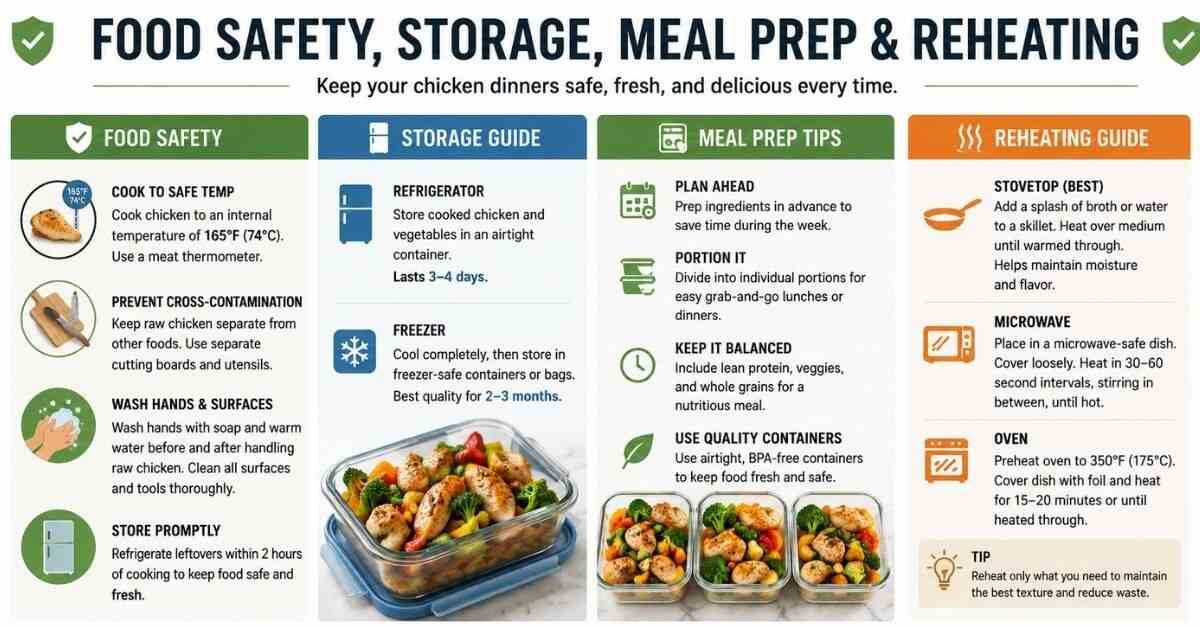
Food safety is an essential part of preparing simple healthy chicken dinners.
Safe Cooking Temperature
According to standard food-safety guidance, poultry should reach an internal temperature of 165°F / 74°C.
Measure the temperature in the thickest portion of the chicken using an instant-read thermometer.
Avoid judging safety solely from the chicken’s exterior color.
Preventing Cross-Contamination
Raw chicken should be kept separate from ready-to-eat foods.
Wash hands with soap and water after handling raw poultry. Clean knives, cutting boards, countertops, and utensils that have contacted raw chicken before using them for other foods.
Do not place cooked chicken back onto the same plate that held raw chicken unless the plate has been properly washed.
Refrigerator Storage
Transfer leftovers to shallow airtight containers and refrigerate promptly.
For best quality and food safety, cooked chicken leftovers should generally be consumed within 3–4 days when properly refrigerated.
Freezer Storage
For longer storage, freeze cooled portions in airtight, freezer-safe containers or bags.
For best quality, use frozen leftovers within approximately 2–3 months.
Reheating
Reheat leftovers until they are thoroughly hot.
Texture is often best preserved on the stovetop. Place the chicken and vegetables in a skillet with a tablespoon or two of broth, cover, and warm gently.
Avoid extremely high heat because it can dry the chicken before the center becomes hot.
For meal prep, divide the chicken and vegetables into individual portions after cooking and cool them appropriately before refrigeration.
Nutrition & Dietary Considerations
The following is an estimated nutrition profile per serving, assuming four servings and the ingredients listed above.
| Nutrient | Approximate Amount |
| Calories | 390 kcal |
| Protein | 47 g |
| Carbohydrates | 14 g |
| Fat | 17 g |
| Fiber | 4 g |
| Sodium | Approximately 550–650 mg |
Actual nutrition values vary based on the size of the chicken breasts, brands of broth and mustard, amount of oil absorbed during cooking, and exact vegetable quantities.
This recipe provides a substantial amount of protein from chicken and fiber from vegetables. It is also naturally free of dairy and gluten-containing ingredients as written, although people following strict dietary restrictions should verify packaged ingredient labels for cross-contact or added ingredients.
For a higher-energy meal, serve it with brown rice, quinoa, potatoes, or whole-grain bread.
For a lower-carbohydrate meal, serve the skillet on its own or with additional non-starchy vegetables.
If you are managing a medical condition or following a medically prescribed diet, use the recipe as a general meal idea and follow guidance from your qualified healthcare professional.
Pairings & Serving Suggestions
One of the strengths of this recipe is its versatility. You can keep it light or turn it into a more substantial family dinner.
With Whole Grains
Serve the chicken over:
- Brown rice
- Quinoa
- Farro
- Barley
The grains absorb the lemon-garlic sauce and make the meal more filling.
With Potatoes
Roasted baby potatoes or air-fried potatoes pair beautifully with the savory chicken and bright lemon sauce.
With a Fresh Salad
A simple green salad with lettuce, cucumber, tomatoes, and a lemon-based vinaigrette creates a refreshing contrast.
Avoid an overly rich dressing because the skillet already contains olive oil.
With Bread
A slice of whole-grain bread is excellent for soaking up the remaining pan sauce.
With Extra Vegetables
For an especially vegetable-forward dinner, add roasted carrots, cauliflower, asparagus, or green beans.
Beverage Pairings
For a non-alcoholic option, chilled sparkling water with lemon or lime complements the citrus profile.
Unsweetened iced tea also works well.
Presentation Tip
For an attractive dinner plate, arrange the vegetables first, add the chicken pieces on top, and finish with fresh parsley and a few thin lemon slices.
A little color contrast makes a simple skillet look considerably more polished.
Yes. Cooked portions can be refrigerated in airtight containers and generally used within 3–4 days when properly refrigerated. Reheat gently with a small amount of broth to help prevent the chicken from drying out. For longer storage, freeze individual portions and use them within approximately 2–3 months for best quality.
Final Verdict & Reader Invitation
A tasty chicken dinner doesn’t have to be complicated, time consuming, or boring with this Lemon Garlic Chicken & Vegetable Skillet. Golden chicken, crisp-tender vegetables, fragrant garlic, and fresh lemon come together in one skillet for a practical meal that feels homemade and satisfying.
If you make this recipe, rate it with your star rating and share your experience in the DaliyDelish.com comments. Tell us which vegetables you used, what substitutions worked for you, or what you’d like to see in the next chicken recipe.
Happy cooking from the DaliyDelish kitchen!
Simple healthy chicken dinners are easiest when they use lean protein, vegetables, straightforward seasonings, and a short cooking method. One main cooking vessel is used to cook this Lemon Garlic Chicken & Vegetable Skillet.
Avoid overcooking it and use an instant-read thermometer rather than relying solely on cooking time. Cut chicken into evenly sized pieces and remove it from the heat once the thickest portion reaches 165°F / 74°C.Cooked chicken can also be improved by resting for a short period of time.
Yes. Skinless, boneless chicken thighs provide a richer taste and are an excellent substitute. Because thighs differ in size and composition, monitor their cooking progress with a thermometer and ensure they reach 165°F / 74°C.
Yes. Cooked portions can be refrigerated in airtight containers and generally used within 3–4 days when properly refrigerated. Reheat gently with a small amount of broth to help prevent the chicken from drying out. For longer storage, freeze individual portions and use them within approximately 2–3 months for best quality.

Tosique Haider -Passionate writer sharing informative, engaging, and easy-to-read articles across different topics. Focused on delivering valuable content that helps readers learn, explore, and stay inspired every day.